Investment and collaboration opportunities
Queensland’s biotechnology sector is part of a booming life sciences ecosystem. Combining our knowledge of biological systems with innovative engineering and manufacturing technologies, Queensland innovators are developing more sustainable and effective solutions to tackle environmental, health, manufacturing, and other industry challenges. For example, Queensland has become a global mRNA vaccine hub with leading healthcare company Sanofi, partnering with the Queensland Government, The University of Queensland and Griffith University to establish the Translational Science Hub in Brisbane.
Queensland biotechnology research is the foundation of several important and emerging knowledge-based industries that are enhancing or disrupting business-as-usual modes of production. Examples of emerging knowledge-based industrial applications of Queensland’s biotechnology science include:
- rapid vaccine development and manufacture
- medical additive biomanufacturing for personalised body parts, scaffolds or medical devices
- biomanufacturing through precision fermentation for:
- alternative food proteins for human consumption
- medicines and pharmaceuticals
- sustainable alternatives for consumables (e.g. textiles, plastics, fuels)
- food and agricultural enhancements for productivity, pest management or crop adaptation to a changing climate
- waste management and climate change mitigation.
Queensland is home to a network of world class key biotechnology research and manufacturing precincts and over 130 research organisations involved in biotechnology research and development.
Leading biotechnology research centres, institutes and precincts
All biotechnology research centres, institutes and precincts
Industry–research collaboration and commercialisation
Bioengineered foods
UQ is leading the Food and Beverage Accelerator project to co-develop nutritious and sustainable new products in partnership with other Queensland universities. Researchers are utilising specialist equipment at the CSIRO BioFoundry to enable the rapid design, build and testing of high-throughput bioengineered products.
Biofuels
Boeing has collaborated with industry partners to develop an advanced new aviation biofuel made from sugarcane. The project utilised the Australian Institute for Bioengineering and Nanotechnology’s IDEA Bio (Integrated Design Environment for Advanced Biomanufacturing), a state-of-the-art facility, to undertake this pioneering research into synthetic biology.
Biorefining
QUT has partnered with Sugar Research Australia to develop probiotic and enzyme feed supplements for enhanced livestock feed. Researchers are utilising the QUT Biorefining Research Facility that includes thePioneer BioPilot (Mackay Renewable Biocommodities Pilot Plant ). The facility provides access to cutting-edge equipment and expertise in fermentation and synthetic biology.
Bioresource recycling
QUT’s Centre for Agriculture and the Bioeconomy have partnered with Meat and Livestock Australia to convert wastes from the agriculture industry into valuable products, such as bioplastics. The Centre has expertise in plant biotechnology, industrial chemistry, and process engineering to develop innovative solutions to improve global food security.
Vaccine development
Researchers at the UniSC’s Centre for Bioinnovation are utilising their biotechnology capabilities to protect the iconic Australian koala. The Centre has developed a vaccine against chlamydia in partnership with the Lone Pine Koala Sanctuary, which is currently being trialled throughout south-east Queensland’s koala population.
Biomedical research
Griffith University’s BioSpine project combines innovative technology that has potential to partially restore movement and sensation in people with spinal cord injuries. Researchers at Menzies Health Institute Queensland have partnered with U.S. Spaulding Rehabilitation Hospital and Harvard University to deliver this novel neural restoration technology.
Bioresource recycling
UniSQ’s Centre for Agricultural Engineering are taking the technical lead in nationwide research that is transforming manure from various agricultural industries into valuable products that can be re-used back on farm. UniSQ is partnering with Scolexia Consulting, and others, to conduct this large-scale project.
Biofoods
The QUT Centre for Agriculture and the Bioeconomy’s Banana Biotechnology program is revolutionising the global banana industry. Supported by the Gates Foundation , researchers have developed a nutrient dense golden biofortified banana, rich in pro-vitamin A. The ‘golden’ bananas have been critical in alleviating macronutrient deficiencies in countries such as Uganda.
Aquaculture biofilters
Researchers at the CQUniversity Coastal Marine Ecosystems Research Centre have partnered with the Australian Seaweed Institute to utilise seaweed as biofilters to reduce nutrient loads and produce valuable bio-products such as fertiliser. The centre is focused on finding economically and environmentally sustainable solutions to coastal threats.
Support for the biotechnology industry in Queensland
Queensland’s biotechnology sector sits within a broader biomedical, biofuels and bioeconomy industry base, linking research, manufacturing, clinical care and global industry partners. Queensland Government support includes the $180.6 million Sovereign Industry Development Fund, which is focused on strategic investment partnerships in defence, biomedical and biofuels.
 Open larger image
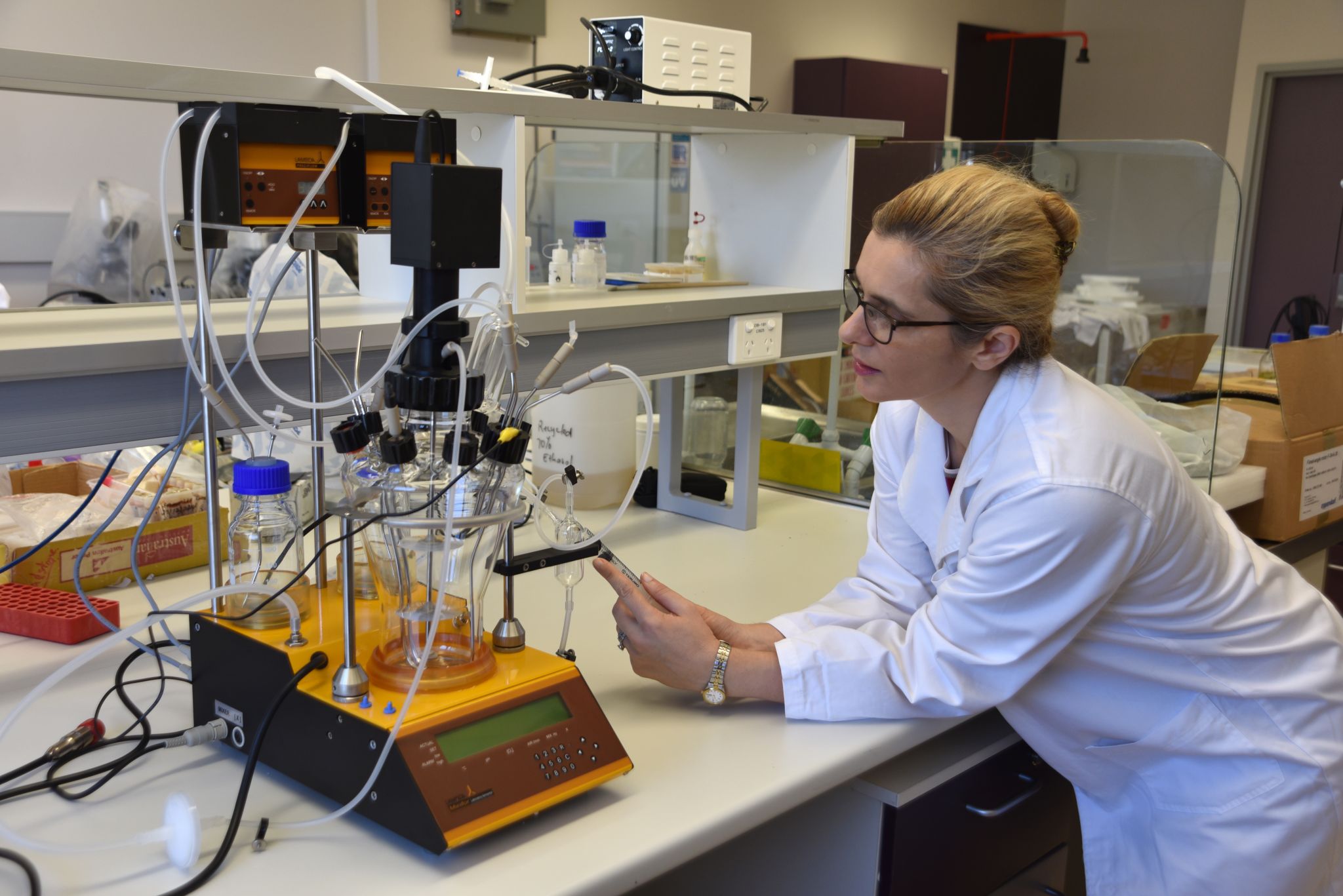
Associate Professor Dana Stanley from CQUniversity Institute for Future Farming Systems working on probiotic nutritional supplements for improved chicken health.
© CQUniversity AustraliaCurrent investments are strengthening Queensland’s biomedical manufacturing and clinical trial capability, including advanced cell therapy manufacturing at ENTRI, targeted alpha therapy manufacturing, sterile fill and finish capability.Queensland is also building international bioeconomy links through the Queensland–Germany Bioeconomy Collaborative Science Program, which supports applied research collaborations in agriculture and agri-food, bio-based products and processes, and biotechnology tools that support a growing bioeconomy.
Queensland will host AusBioInvest and the AusBiotech International Conference in 2026 and 2027, giving the state further opportunities to showcase its biomedical and biotechnology strengths to national and international investors, companies and research partners.
Life Science Queensland is a peak industry body, attracting investment and amplifying talent.
Talent pipeline for biotechnology
Most Queensland universities offer undergraduate and postgraduate courses in biotechnology, supported by major research institutes and specialised centres that build advanced biotechnology research and development capability.
Students and early-career researchers can develop skills through university, industry and government partnerships across biotechnology, biomanufacturing, bioeconomy and biomedical
Queensland for Biomed
Find out how Queensland is on the cusp of a biomedical boom.
Traditional knowledge and biodiscovery in Queensland video
Watch the Traditional knowledge and biodiscovery in Queensland video to learn more about biodiscovery in Queensland and the importance of protecting traditional knowledge.