Queensland has an extensive protected area network that includes national parks, conservation reserves, nature refuges and other protected areas. The state's protected area system exceeds 14.9 million hectares and includes more than 5 million hectares of privately protected land.
Great Barrier Reef; the Wet Tropics rainforests; the Gondwana rainforests and K’gari (Fraser Island). Queensland has some of the best managed large ecosystems on Earth. To understand and manage our megadiverse landscapes, four climatic zones and the impacts of environmental extremes (flood, fire and drought), urban and industrial development and climate change, Queensland has developed a sophisticated and extensive environmental research and natural area management capability.
Based on their expertise as the world’s first scientists and traditional custodians, over 150 First Nations land and sea rangers operate across 37 remote and regional communities. Many national parks now operate under co-stewardship partnerships with First Nations peoples. Queensland was the first Australian state to introduce biodiscovery legislation for the collection and analysis of native biological material for commercial use that establishes access to the resource under full and informed consent and a benefit-sharing agreement with First Nations people in alignment with the Nagoya Protocol.
Queensland has research expertise in natural systems which reflects the diversity and significance of Queensland’s environments. Areas of focus include aquatic ecosystems and health, reef science including world-leading reef resilience measurements, flora and fauna, understanding and mapping of biodiverse landscapes and soils, and fire ecology.
We also have expertise working with different sectors on environmental sustainability, reducing the impacts of human and economic activities on natural systems including catchment monitoring, management and modelling for air and water quality outcomes; mining remediation; biocontrols; water sensitive urban design; and renewable energy.
Queensland has several leading institutes and centres and over 100 research organisations involved in advanced manufacturing research.
Leading environment and nature research centres
All environment and nature research centres
Industry-research collaboration and commercialisation
Novel water technologies
To accelerate their world-class research and enable increased adoption of new technology within the water industry, the Australian Centre for Water and Environmental Biotechnology have formalised their decades long collaboration Urban Utilities in a 5-year strategic alliance to test and demonstrate novel water technologies in real world conditions.
Environmental Artificial Intelligence
To meet national water quality targets to ensure only very low concentrations of herbicides enter the Great Barrier Reef, the JCU Centre for Tropical Water and Aquatic Ecosystem Research (TropWATER), Sugar Research Australia and
AutoWeed Pty Ltd have developed a smart spot spraying that uses deep learning to detect and spray weeds.
Marine research
Seagrasses, vital for healthy coastal ecosystems, are in decline globally. The Seagrass Restoration Research Program at CQUniversity Coastal Marine Ecosystems Research Centre is collaborating with the Gladstone Ports Corporation and other partners to explore ways to restore and grow seagrass meadows in the sub-tropical Port of Gladstone estuary.
Climate and bushfires
To provide sound scientific advice on post-fire forest management in response to Australia’s catastrophic 2029–2020 Black Summer fire, the Griffith Climate Action Beacon, the Bushfire Recovery Project is a collaboration between the Australian National University and community volunteers in the Gondwana Link and the Great Eastern Ranges landscapes.
Cyclone resilience
To increase the resilience of communities to future tropical cyclones, the Cyclone Testing Station of the JCU Centre for Disaster Studies is drawing upon decades of cyclone research to offer total cyclone resilience inspections for free to all Bodies Corporate in north Queensland eligible under the North Queensland Strata Title Inspection Program.
Fauna conservation
The University of the Sunshine Coast (UniSC) Detection Dogs for Conservation is the only university research group which trains, tests and deploys detection dogs for conservation in Australia works with partners such as WWF, industry and governments.
AI robotics
In a major contribution to protecting the world’s largest coral reef, the RangerBot AUV was developed by the QUT Centre for Robotics with the Great Barrier Reef Foundation. The AI and vision-based robotic tool successfully delivers coral larvae to damaged reefs, monitors coral bleaching and maps and kills the Crown-Of-Thorns Starfish (COTS).
Pest control and the environment
After a decade of research, a safe sustainable alternative to chemical pesticides that is effective against whitefly (Bemisia tabaci) which attacks 500 crops and costs billions of dollars, has been developed as part of UQ’s BioClay™ technology. The Centre for Horticultural Science and Nufarm Limited are now in field trials with several key crops.
Climate change adaptation
Older people are more vulnerable to extreme and frequent heat episodes. Funded by Wellcome, researchers at Griffith Climate Action Beacon are working closely with older persons, their in-home carers and key organisations (e.g. COTA and QFES) on the EtHOs project to develop an individualised early warning system for older people living at home.
Contact the commercial partnership offices of Queensland universities and research institutes for details of their research-industry collaboration or investment opportunities.
Support for the environment and nature research in Queensland
 Open larger image
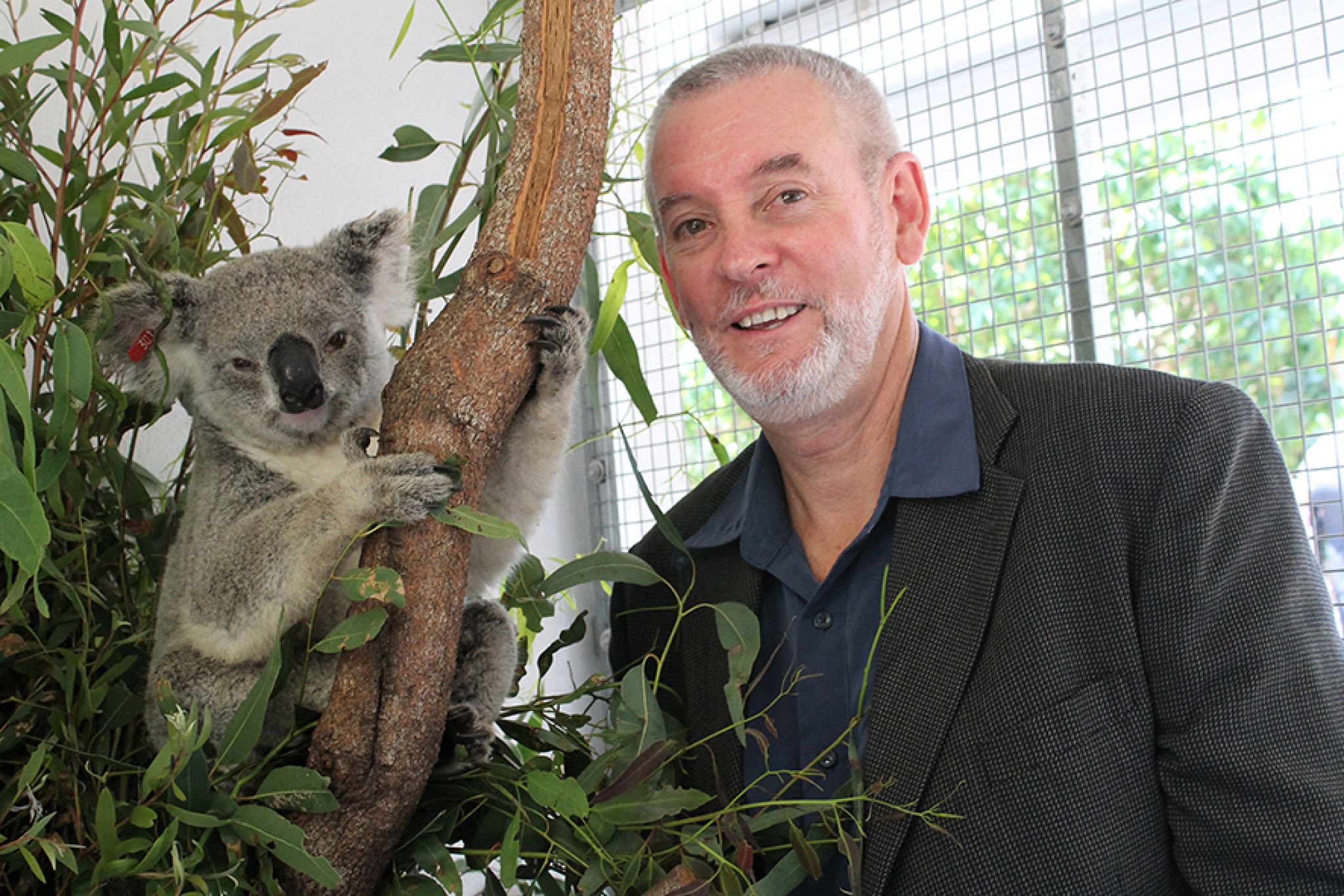
Koala chlamydia vaccine researcher Prof. Peter Timms from Centre for Bioinnovation.
The Department of the Environment, Tourism, Science and Innovation is the lead Queensland Government agency for legislative and management responsibility for environmental, species and ecosystem protection, research and monitoring.
Queensland has a strong network of volunteer and professional organisations supporting the management and protection of Queensland’s unique environment. There are 12 formal regional natural resource management bodies in Queensland responsible for delivery of regional-level NRM outcomes in partnership with industry, community and government. Queensland Water and Land Carers is the peak body for natural resource management volunteers consisting of 456 groups and 38,000 individuals.
There is also a network of local on-ground volunteer environment groups, regional conservation councils and the peak Queensland Conservation Council along with dozens of state-level organisations representing particular interests such as Birds Queensland. The citizen science movement, that involves the collection and analysis of scientific data by citizens in collaboration with scientists and field experts is very active with hundreds of citizen science projects operating in Queensland.
he Queensland and Australian governments have invested in significant infrastructure to support environmental research in Queensland including: the Australian Institute of Marine Science (AIMS), Australia’s premiere tropical marine research agency; the Queensland Herbarium and the Australian Tropical Herbarium; the Australian Tropical Science and Innovation Precinct; and the Ecosciences Precinct.
Talent pipeline for environment and nature
 Open larger image
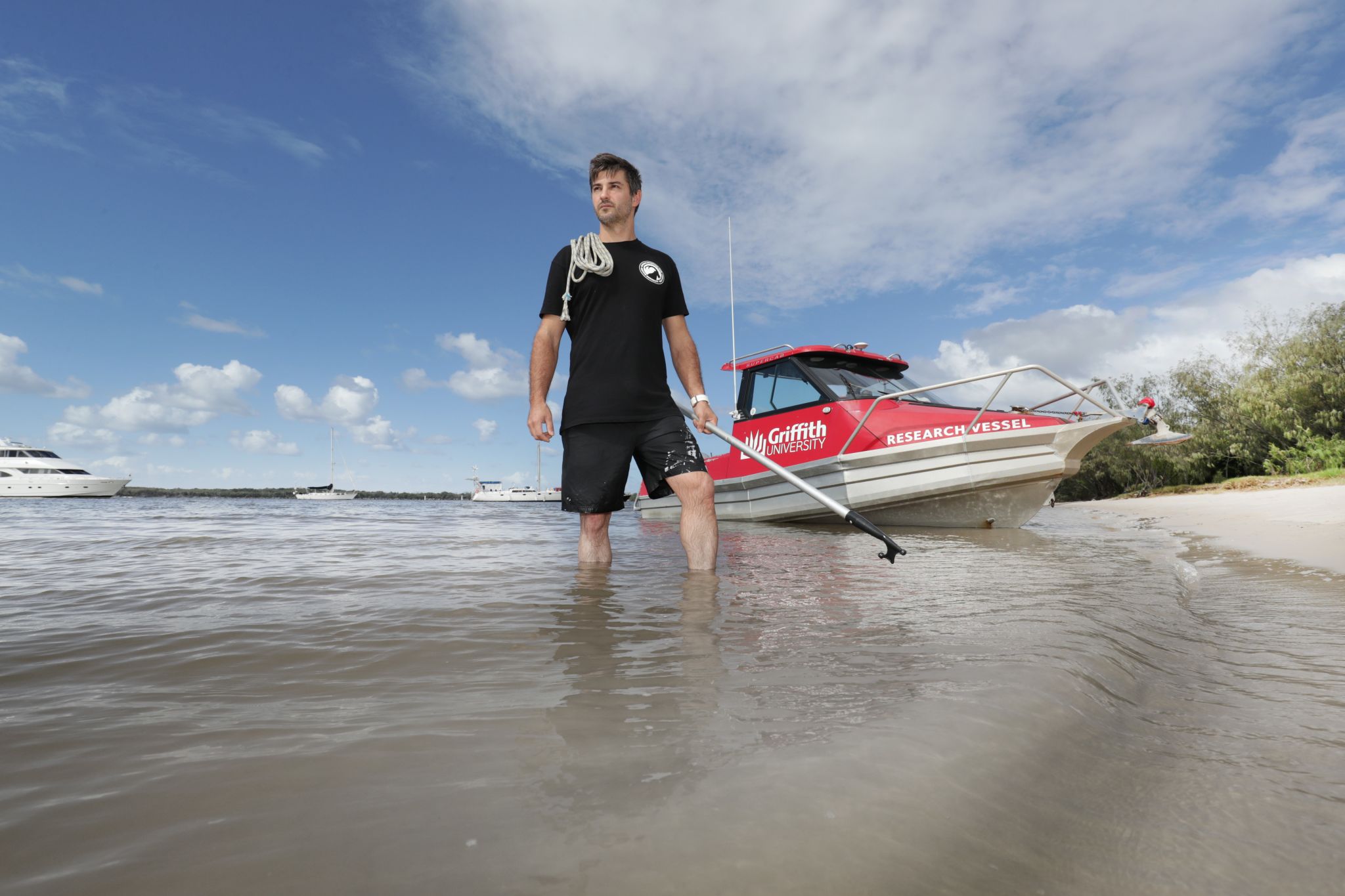
Marine biologist Johan Gustafson from the Griffith Coastal and Marine Research Centre specialises in shark ecology.
Most Queensland universities manage major environment and nature research programs in dedicated research institutes and centres.
Environmental practioners can maintain their professional standing with the support of organisations such as the Environment Institute of Australia and New Zealand and their accreditation via the independent statutory body, the Board of Professional Engineers of Queensland that operates under the Professional Engineers Act
From their earliest years students in Queensland engage with STEM subjects (Science, Technology, Engineering and Mathematics) under the strategy for STEM in Queensland state schools and teachers access resources via the STEM Hub and the Queensland Virtual STEM Academy (QVSA).
Coastal science
Queensland’s long coastline is the interface between land and marine ecosystems. Our researchers contribute to managing the coastal zone including how to protect areas while enabling their use.
“Queensland Science COASTAL making a difference”
Prof Britta Shaffelke
Research Program Leader - Sustainable Coastal Ecosystems and Industries in Tropical Australia
A Healthy and Resilient Great Barrier Reef
Australian Institute of Marine Science
Coastal ecosystems are very important. It’s where most of the world’s population is living. That’s where also the food sources are.
Globally coastal ecosystems are under immense pressure. It’s a challenge to keep them healthy but also to make them available for use.
[Caption: Queensland Science…COASTAL…making a difference]
Here in the National Sea Simulator we disentangle the different local pressures and global pressures.
Like land run-off and the effects on the Great Barrier Reef.
[Caption: Protecting the reef]
We are collaborating quite widely with industries scientists and government because it’s an issue that affects everybody.
Paul Lawrence
Director, Landscape Sciences
Department of Science, Information Technology and Innovation
The challenge of the science that we are undertaking is to develop improved land management practices with industries and with community bodies. Our integration of water quality monitoring with our modelling and development of decision support tools will have application to areas right around the world.
Prof Stuart Phinn
Director, Remote Sensing Research Centre
School of Geography, Planning and Environmental Management
The University of Queensland
The area that I work in is remote sensing using airborne and satellite images to map essentially what is on the ground or in the water. We look at changes in environment over time. We’re actually able to build and test algorithms to assess how effective different land management practices reduce surface runoff, reducing soil erosion. We know our work is making a difference because of the range of environments we have in Queensland. The science which is developed here is being picked up and used internationally, applied in a lot of places around the world.
Warwick Nash
Science Director
Fisheries Aquaculture and Sustainable Intensive Livestock Systems
Department of Agriculture and Fisheries
The demand for seafood globally is high and it’s increasing. And this demand can only be met by aquaculture. Fishing is really important to Queensland’s economy, the pressures on wild stocks will continue as well managed fisheries will continue to be important. Queensland’s got a very long coastline and we have very many fish species. Fishery biologists and fishery scientists have been gathering information on the fish stocks for many years.
Other states I think admire what we do. The team of very highly skilled mathematicians provide the assessments that give confidence in being able to manage the fisheries in a way that they can be sustained into the future. Their skills are sought after both in Australia and elsewhere around the world.
Professor Rodger Thomlinson
Coastal Program Leader, Climate Response
Griffith University
Being on the coast means you are exposed to hazard, the ocean is a wild place at times. Queensland is a leader in coastal science and coastal engineering and in modelling the processes that go on. Delegations are coming to Queensland because of our experience and history in managing our coasts.
And we’ve put a lot of effort into understanding the nature of the coastal hazard. Things such as storm surge – how quickly do they develop and what level of impact do they have. The modelling work that happens in Queensland is really making a difference to improve our resilience on the coast.
Paul Lawrence
Our science is making a huge difference not just within the coastal zone but also in the sustainability of our industries.
[Caption: Protecting the reef]
Warwick Nash
Queensland science
Paul Lawrence
Making a real difference
[Captions: Queensland Science…Making a difference…Coastal]
[Caption: Come join us]
[Logo: ADVANCE Queensland Jobs now, jobs for the future]
[Caption: Queensland Science Making a difference…Coastal]
[Caption: Find out more] www.science.qld.gov.au
[Logo: Queensland Government]
Water science
Managing water quality and quantity is critical everywhere, and has resulted in Queensland developing expertise in water and wastewater management technologies and solutions, reef science.
“Queensland Science making a difference WATER”
Associate Professor Eva Abal
Director, Sustainable Water Program
Global Change Institute
The University of Queensland
The world has always been very much concerned about water quantity. Now water quality will become a major issue.
Queensland science in water is helping to improve water quality by developing technology around solutions, the economics and the regulatory framework, and the planning mechanisms.
[Caption: Bringing Solutions Together]
Queensland is sharing its knowledge with neighbours and other countries.
There is definitely a lot of passion in making our rivers cleaner around the world.
[Caption: Queensland Science… WATER…Making a difference
Prof Michele Burford
Executive Deputy Director
Australian Rivers Institute, Griffith University
Our research which is really aimed at understanding ecosystem health can help us identify where in the landscape the problem areas or hotspots are. Our approaches are highly applicable to trying to solve worldwide problems. It is really important for us to come up with cost effective solutions to help Aquaculture in both Australia and developing countries to work more sustainably.
Researchers at the Australian Rivers Institute have been working in China for more than 10 years developing a report card system that they can use in their rivers systems.
[Caption: Contributing globally]
People come to us from around the world because we can help them.
Professor Zhiguo Yuan
Director, Advanced Water Management Centre
The University of Queensland
My research aims to provide knowledge to the waste water industry to more effectively manage waste water. Sewer corrosion is a huge issue in Australia and also worldwide.
And the industry spend a lot of money to manage sewer corrosion.
[Caption: Solving worldwide problems]
In addition to developing modelling tools like Sewex, we also developed some new technologies that enables the water industry to take a more proactive approaches to managing sewer corrosion.
Australian water utility have already…achieved cost savings of $400million so far and worldwide this will go even further beyond.
Paul Heaton
Director
Gold Coast Waste and Water
City of Gold Coast
The Gold Coast has five rivers, it has 50 kilometres of beaches, and 500 kilometres of waterways. Every year we attract something like 11 million visitors to the Gold Coast and we can only see that increasing.
[Caption: Balancing our needs with nature]
The challenge for the future for us is to achieve the right balance between development and our environment - water quality is our number one priority
The science underpins nearly everything that we do. There is no doubt that our scientific collaborations with universities and government departments has made an enormous difference to the outcomes we’ve been able to achieve here on the Gold Coast.
Together with Queensland Science, we’re making a difference for water.
Eva Abal
Queensland science
Michele Burford
Making a difference
[Captions: Queensland Science…Making a difference]
[Caption: Come join us]
[Logo: ADVANCE Queensland Jobs now, jobs for the future]
[Caption: Queensland Science Making a difference]
[Caption: Find out more] www.science.qld.gov.au
[Logo: Queensland Government]
Traditional knowledge and biodiscovery in Queensland video
Watch the Traditional knowledge and biodiscovery in Queensland video to learn more about biodiscovery in Queensland and the importance of protecting traditional knowledge.
Water releases
Read how we monitor and track water releases.